

Everything ready
From hosting to site edits. The service includes everything necessary.
Service quality
We thoroughly test your site to ensure everything works before launch.
 Everything ready
 Service quality
Website development — often an underestimated area
Website development
The technical implementation of a website significantly affects functionality, performance, search visibility and usability. Although websites can be built with different tools and content management systems, the final result always consists of HTML, CSS and JavaScript code. These three languages define the structure, appearance and functionality of the site.
A website can be built manually or with ready-made tools. The latter is fast and easy to use but may produce a large amount of unnecessary code that slows down the site and makes optimization harder. Such a site may also depend on third-party plugins whose poor maintenance can cause security risks and/or malfunctions.
Site performance and amount of code
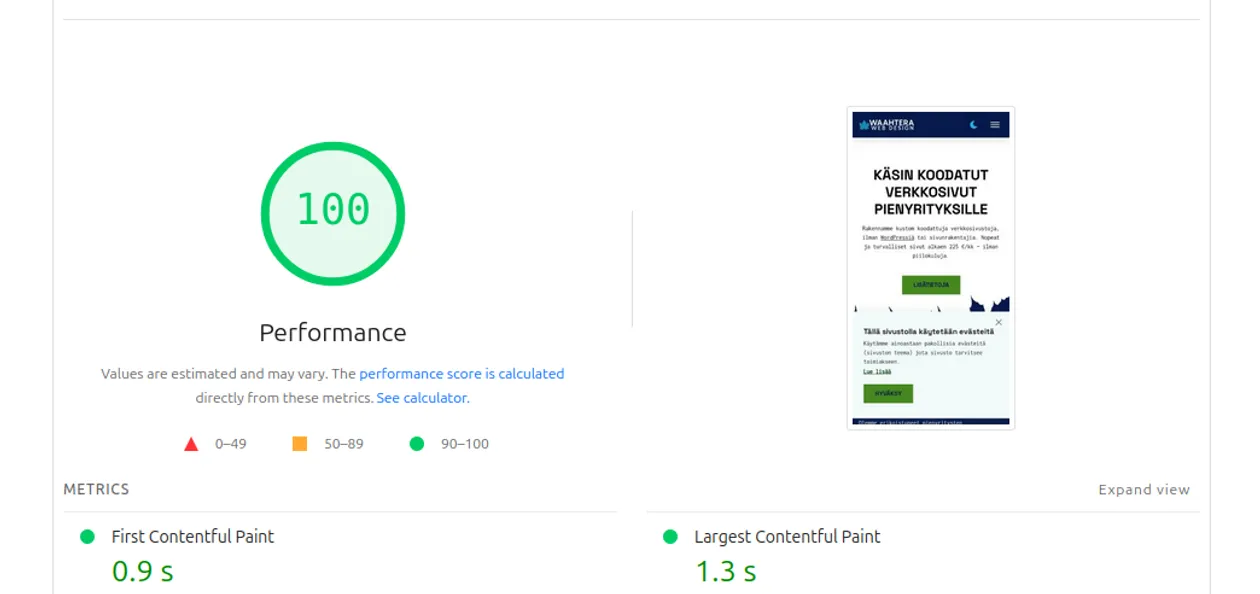
A website consists of files that the browser downloads and interprets. The amount of downloadable content and code used can significantly increase loading time. Page speed affects user experience and performance, which in turn affect search rankings.
Website performance is affected by for example:
- Number and size of files
- Compression of images and other media files
- Server response time and the content delivery network (CDN)
- Technical implementation such as render-blocking resources and management of external resources
Security and software architecture
Many websites include a backend system, database and administrative login features. These naturally introduce security responsibilities. Every plugin, open connection or login page can become a potential attack surface if the site is not properly secured or updated.
Accessibility
Accessibility means the website is usable also for people with visual, hearing or motor impairments. Internationally accessibility is guided by WCAG standards (Web Content Accessibility Guidelines), applied in the public sector but also increasingly in the private sector.
Basic accessibility principles include for example:
- Image alt texts
- Clear structure and logical heading hierarchy (h1-h6)
- Sufficient color contrast
- Working keyboard navigation
- Text alternatives for icons and buttons (for example ARIA labels)
Can lack of accessibility cause problems?
If your website is not accessible, it may violate legislation. Many countries and also the European Union, have introduced accessibility requirements for online services. Any company operating within the EU must comply with accessibility directives. This means if you want to sell or market services in the EU, your website must meet WCAG 2.1 standards.